What’s New In Direct to Film Printing This Year
With almost half of 2026 behind us, one thing is clear: direct to film printing (DTF) deserves extra attention.
DTF printing has become one of the most talked-about technologies in garment decoration. It’s flexible, accessible, and attractive to businesses that want to produce custom apparel without the setup time of traditional screen printing.
But 2026 is also showing the other side of the story.
The market is getting crowded. Many machines look similar. More suppliers are chasing the same growth. And for print businesses that want to scale, buying a low-cost DTF printer is no longer enough.
The real question is changing from “Can we print?” to “Can we build a profitable, repeatable, and scalable production operation?”
Key Takeaways
- DTF printing is still growing, but the market is becoming more crowded and harder to differentiate.
- Automation, workflow software, and color control are becoming more important than machine price.
- Small operators and industrial decorators need very different production strategies.
- Kornit’s platform approach supports the move toward connected, scalable digital production.
Why DTF Printing Feels Different in 2026
So what changed over the last five months? Some changes are subtle but very telling.
DTF Is Still a Growth Market
Direct to film printing is popular because of the low entry barrier and consumable costs. Due to that, more and more suppliers and vendors enter the market, and some bring questionable quality.
Meanwhile, DTFilm has the potential to support detailed designs and a wide range of garment types.
That makes it useful for:
- Custom apparel shops
- Promotional product businesses
- Print-on-demand companies
- Small brands
- Larger decorators adding flexible capacity
At FESPA 2026, major print technology suppliers continued to highlight DTF, textile, workflow, and color tools as part of the production conversation. Epson, for example, presented Direct-to-Film systems alongside workflow and color tools for professional production.
But Easy Entry Creates a New Problem
The low cost of entry is one of DTF’s biggest strengths.
It is also one of its biggest challenges.
For a small operator printing a few dozen pieces a week, DTF can be a great enabler. The investment is lower. The learning curve is shorter. The path to market is faster.
But for industrial decorators, the game is different.
When a business needs to produce hundreds or thousands of garments a day, the machine price is only one part of the story. Labor, software, color, uptime, consistency, and finishing all become just as important.
That is where many print operations start to feel the gap between printing products and running production.
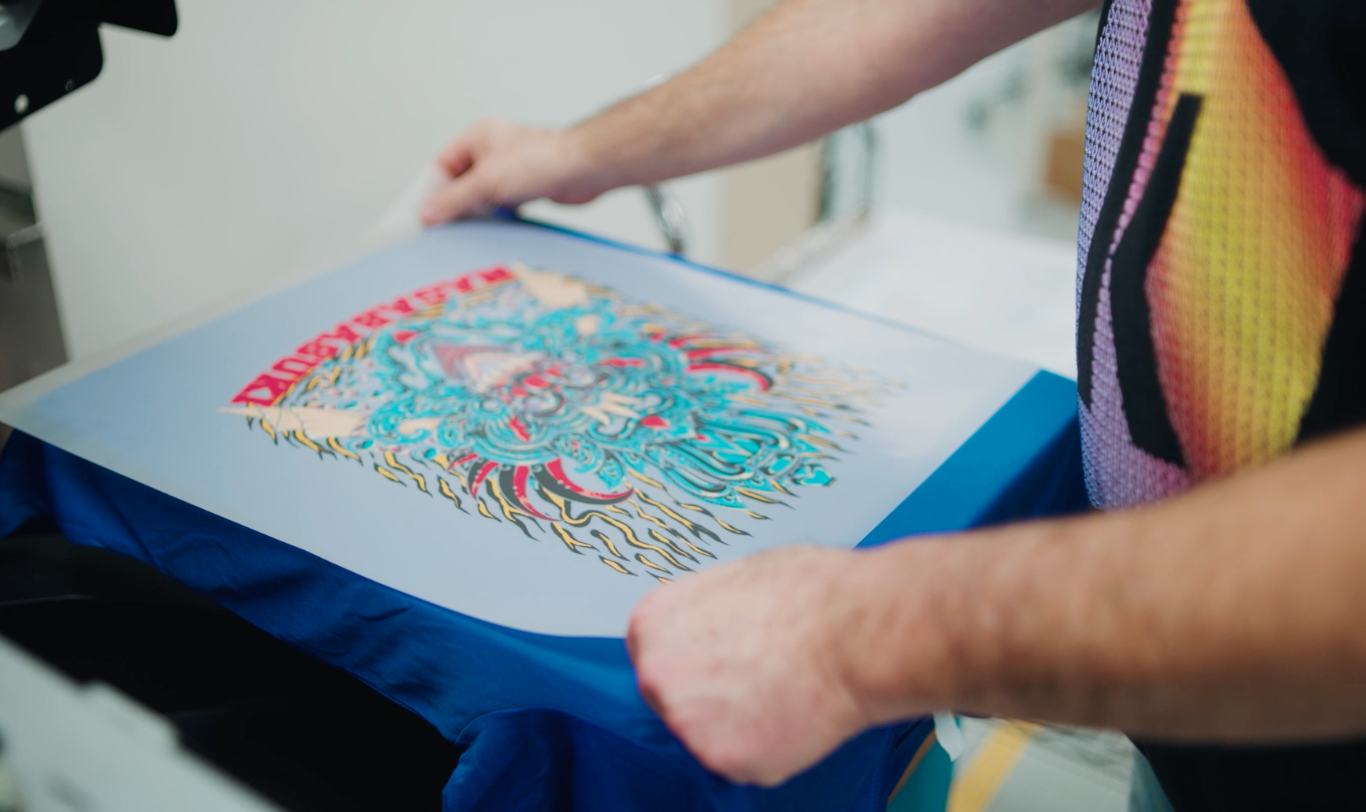
What’s New in DTF Printing in 2026?
So, can changes in DTF printing accommodate what industrial-size companies are looking for?
1. Automation Is Becoming a Must-Have
A shop running one or two printers can often manage manual steps. A larger operation cannot rely on constant handoffs, checks, and fixes.
Every extra manual step creates the risk of:
- More labor costs
- More delays
- More production errors
- More waste
- More quality variation
This matters because DTF has many moving parts. There is printing, powder or adhesive handling, curing, transfer storage, heat pressing, quality control, and order management.
At scale, these steps need to work together. Otherwise, the printer may be fast, but the workflow around it becomes slow.
2. Workflow Software Is Now the Real Battleground
For many print businesses, the biggest bottleneck is not the printer. It is the workflow.
Orders come from different systems. Files need to be prepared. Colors need to be managed. Jobs need to move through production. Operators need clear instructions. Managers need visibility.
Without strong software, volume becomes messy.
That is why workflow is becoming central to the DTF conversation in 2026. Kornit’s acquisition of PrintFactory is directly connected to this shift. PrintFactory provides cloud-based workflow, RIP, color management, and automation solutions for professional print production, with more than 10,000 users globally.
For industrial decorators, this is critical.
Good workflow software helps connect the parts of production that often sit apart: order intake, file preparation, color management, printing, finishing, and fulfillment.
In simple terms, workflow software helps answer a basic question:
Can the business produce more without adding chaos?
3. Color Consistency Is Becoming a Bigger Test
A hobbyist may accept a print that is “close enough.” A global brand will not.
Industrial customers expect repeatable color across jobs, garments, machines, and locations. If the same logo looks different from one order to the next, consistency is ruined.
This is why color management is becoming more important in DTF production. It is also why software, calibration, ink control, and repeatable processes matter so much.
Industry coverage has also pointed to software improvements around white ink, lower curing temperatures, durability, stretch, and softer hand-feel as part of the continuing innovation in DTF and garment decoration.
4. DTF Is Moving Toward More Industrial Thinking
A major shift in 2026 is the move from machine-by-machine thinking to system thinking.
In the early DTF wave, many businesses focused on access. Could they enter the market? Could they print custom designs? Could they offer short runs?
Now, more businesses are asking bigger questions:
- How many operators do we need per shift?
- How many touches does each order require?
- Can we reduce reprints?
- Can our color stay consistent?
- Can our workflow handle growth?
- Can we profit at scale?
These are not small questions. They decide whether a print shop grows or gets stuck.
A cluster of low-cost machines may look attractive at first. But if each printer requires too much manual attention, the labor cost can erase the savings.
For industrial production, the better question is not only “What does the printer cost?”
It is “What does the full production model cost?”
Sustainability Is Becoming More Practical
Sustainability in DTF printing tends to revolve around inks, films, powders, and chemistry. These are important.
But in 2026, sustainability is also becoming more operational.
A more sustainable production model should reduce:
- Failed prints
- Overproduction
- Unnecessary inventory
- Excessive manual handling
- Energy-heavy rework
- Waste from poor color matching
That means sustainability is closely tied to efficiency.
When a print business gets more orders right the first time, it saves materials and labor. This is not just better for the environment. It is better for margins.
Where Kornit Fits in the DTF Conversation
Kornit’s position in this conversation is far beyond chasing the cheapest entry point. It’s about helping print businesses move toward a more automated and scalable production model.
That matters because the DTF market is becoming crowded. When many suppliers offer similar hardware, differentiation has to come from somewhere else.
For industrial players, the difference may come from the full architecture of production: automation, software, color, quality, durability, service, and business model.
A Platform Approach to Digital Production
Kornit’s broader direction supports this shift. The latest addition, Kornit Atlas MATRIX, is a unified, media-agnostic workflow for cotton, polyester, and blends. It’s powered by MAX and Karbon Technology. The latter enables fully digital, migration-free direct printing on dyed polyester and performance fabrics, combined with advanced Direct-to-Film capabilities, all powered by DigiBlocker™ – Kornit’s proprietary digital ink blocker.
This kind of approach reflects where the industry is heading.
The future of garment decoration will not be built only around isolated machines. It will depend on connected production systems that can manage demand, print quality, workflow, and fulfillment more intelligently.
That is especially important as DTF, DTG, screen printing, and other methods continue to exist side by side.
What Should Print Businesses Ask Before Investing in DTF in 2026?
Before buying or expanding DTF capacity, businesses should ask:
- How many manual steps are required from the file to the finished garment?
- How many operators are needed to support real daily volume?
- Can the workflow handle more orders without slowing down?
- How consistent is color across jobs and repeat orders?
- What happens when production needs to scale quickly?
- How much waste comes from errors, reprints, or poor file preparation?
- Does the system support the type of customers the business wants to serve?
These questions help separate a low-cost setup from a scalable production model.
Final Thoughts: DTF Is Growing Up
The technology is accessible. The market is growing. The demand for custom, on-demand apparel is strong.
But the next phase can’t be won by hardware alone.
It will be won by businesses that understand the full production picture: labor, automation, workflow, color, quality, sustainability, and growth.
For small operators, DTF can still be a great way to enter the market.
For industrial decorators, the challenge is bigger. They need systems that help them grow without adding friction at every step.
That is where Kornit’s focus on connected and scalable digital production becomes especially relevant. In a crowded DTF market, the real advantage is not just being able to print.
It is being able to produce smarter.
Want to learn more about Kornit’s systems? Let’s talk.